nPalm syrup is widely used as a natural sweetener in beverages, sauces, and culinary applications. However, one recurring issue in international trade is the development of mold or unintended fermentation during long-distance shipping.
For importers and food manufacturers, this issue is not only a quality concern but a financial and reputational risk. A single container arriving with unstable product can lead to rejected shipments, customer complaints, and brand damage.
Understanding why palm syrup develops mold or ferments during transportation is essential for preventing these risks.
The root cause often lies not in the shipping duration itself, but in production discipline and hygiene control from upstream to downstream.
The Primary Cause: Lack of Hygiene from Upstream to Downstream
Palm syrup can develop mold during shipping for many reasons, but the most critical factor is poor hygiene throughout the entire production chain.
From sap collection at the farm level to filtration, evaporation, filling, and packaging, hygiene standards determine microbial stability.
If sap collection containers are not properly sanitized, natural yeast and bacteria begin multiplying before processing even starts. When filtration systems are not cleaned regularly, microbial contamination may remain in the syrup. If filling equipment is exposed to environmental contaminants, spores can enter the final product.
When hygiene is not strictly controlled from upstream to downstream, the syrup may appear normal at dispatch but becomes unstable during long transit periods.
Microbial contamination does not always cause immediate spoilage. During a 30–45 day ocean freight journey, especially in fluctuating temperatures, residual microorganisms can multiply and cause fermentation or mold growth.
Shipping does not create contamination. It reveals contamination that already exists.
Moisture Content and Water Activity
Moisture level plays a significant role in microbial growth.
If palm syrup contains excessive moisture due to incomplete concentration or hidden dilution, the water activity increases. Higher water activity creates a favorable environment for mold and yeast growth.
Properly concentrated palm syrup maintains controlled moisture levels that limit microbial activity. When evaporation parameters are not standardized, moisture variation becomes a risk factor.
During long-distance shipping, temperature fluctuations may further activate microbial growth if moisture control is inadequate.
Moisture stability is therefore not only a quality issue but a preservation strategy.

Temperature Fluctuations During Ocean Freight
Long-distance shipping exposes products to temperature changes. Containers may experience heat during loading, cooling at sea, and varying humidity levels.
If palm syrup is not microbiologically stable before shipment, temperature variation accelerates fermentation.
Fermentation occurs when residual yeast converts sugars into alcohol and gases. This can lead to swelling packaging, altered flavor, and off-odor.
Mold growth, on the other hand, typically appears on the surface when spores are present and conditions become favorable.
Professional export-grade palm syrup must be prepared with long transit in mind. Stability must be engineered before shipment.
Packaging Integrity and Sealing Standards
Even properly produced palm syrup can face contamination risks if packaging is inadequate.
Poor sealing allows oxygen ingress. Oxygen exposure supports mold growth. Weak packaging materials may also permit external contamination or leakage during transit.
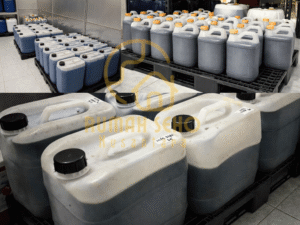
Export-oriented manufacturers use packaging systems designed for long ocean freight. Sealing integrity, container sanitation, and secondary packaging all contribute to maintaining product stability.
Shipping resilience begins with packaging discipline.
The Difference Between Traditional and Controlled Production
Traditional palm syrup production methods often prioritize artisanal character. While valuable in local markets, these methods may lack industrial hygiene control required for international export.
Modern export production requires:
- Controlled evaporation temperatures
- Defined moisture targets
- Sanitized filtration systems
- Closed filling environments
- Microbial monitoring procedures
Without these controls, syrup stability becomes unpredictable during long-distance transport.
Consistency in hygiene is not optional for exporters. It is essential.
PT. Rumah Seho Nusantara: Producing Palm Syrup Designed for Long-Distance Stability
As a premium palm sugar syrup (Arenga) manufacturer and supplier from Indonesia, PT. Rumah Seho Nusantara understands that export stability begins at production level.
Our production system emphasizes hygiene from upstream to downstream. Sap handling procedures, controlled processing conditions, and clean filling systems are implemented to minimize microbial risk.
Moisture parameters are monitored to ensure concentration stability. Packaging is prepared with long-distance ocean freight conditions in mind.
We recognize that shipping does not forgive production shortcuts. Therefore, our approach focuses on preventing contamination at its source rather than reacting to spoilage after arrival.
For importers and manufacturers, this translates into predictable performance and reduced rejection risk.
Building a Long-Term Strategic Partnership with L’Arbre Seho
Why Stability Matters for Importers
When palm syrup develops mold or fermentation during shipping, the consequences extend beyond product loss.
There are freight costs, customs complications, potential insurance disputes, and reputational damage with distributors or retailers.
More importantly, inconsistent stability weakens confidence in the supplier relationship.
Importers require partners who understand that product integrity must survive 30–45 days of transport without degradation.
Stability protects margins, protects trust, protects brands.
Conclusion
Palm syrup can develop mold or ferment during long-distance shipping for several reasons, but the most critical factor is inadequate hygiene throughout the production chain from upstream to downstream.
Moisture imbalance, microbial contamination, temperature fluctuation, and packaging weaknesses all contribute to instability when production discipline is lacking.
Shipping does not create problems. It exposes weaknesses in processing standards.
For importers and manufacturers seeking reliable export-grade palm syrup, choosing a producer that prioritizes hygiene control, moisture stability, and packaging integrity is essential.
In global trade, long-distance resilience is not accidental. It is engineered.
For More Information : +6289698882428 (WhatsApp)