The Global Palm Syrup Industry: Market, Manufacturing, and Future Demand
Introduction: Understanding the Global Palm Syrup Industry
The global food and beverage industry continues to evolve as consumer preferences shift toward natural ingredients and transparent sourcing.
Sweeteners represent one of the most dynamic segments within this transformation. Manufacturers are exploring alternatives that offer not only sweetness but also natural origin and distinctive flavor characteristics.
Within this context, the global palm syrup industry has begun attracting increasing attention from both manufacturers and importers.
Palm syrup, derived from the sap of the Arenga palm tree, has long been used as a traditional sweetener in several regions of Southeast Asia. However, in recent years it has begun entering international markets as a natural ingredient for modern food and beverage formulations.
As global demand for natural sweeteners grows, the palm syrup industry is gradually expanding beyond its traditional markets.
Understanding the market dynamics, production systems, and future opportunities within the global palm syrup industry is therefore increasingly important for manufacturers and ingredient buyers.
What Is Palm (Arenga) Syrup?
Palm syrup is produced from the sap of the Arenga palm tree, scientifically known as Arenga pinnata.
Harvesters collect fresh sap from the flower stalks of mature trees using traditional tapping techniques. The sap naturally contains sugars, minerals, and organic compounds that give palm syrup its distinctive characteristics.
After harvesting, the sap undergoes filtration and controlled evaporation to concentrate the sugars and produce syrup.
The final product offers balanced sweetness and subtle caramel-like flavor notes.
Because of its liquid form and natural origin, palm syrup has become increasingly attractive for food manufacturers seeking alternative sweeteners.
Within the global palm syrup industry, Arenga palm syrup is often considered a premium natural sweetener suitable for beverages, desserts, and culinary applications.
The Natural Geography of Palm Syrup Production
Palm syrup production is closely linked to the natural distribution of the Arenga palm tree.
These trees grow naturally in tropical climates, particularly in Southeast Asia.
Indonesia is widely recognized as one of the most important regions for Arenga palm cultivation.
The country’s tropical ecosystem supports the growth of millions of Arenga palm trees across mountainous and forested areas.
Because the raw material grows naturally in these environments, Indonesia plays a major role within the global palm syrup industry.
In addition to Indonesia, smaller-scale palm syrup production also occurs in countries such as the Philippines and Thailand.
However, Indonesia’s extensive palm tree population and harvesting traditions give it a unique advantage as a global supply source.
Traditional Harvesting Meets Modern Manufacturing
Palm sap harvesting has been practiced for centuries in many rural communities.
Harvesters climb Arenga palm trees and tap the flower stalks to collect fresh sap in containers.
This traditional knowledge forms the foundation of palm syrup production.
However, producing syrup suitable for international markets requires more than traditional harvesting.
Modern manufacturing systems are necessary to ensure consistent ingredient quality.
Within the global palm syrup industry, reliable producers combine traditional sap harvesting with modern processing techniques.
Controlled evaporation systems concentrate the sap under monitored conditions. Hygienic production environments help prevent contamination.
These improvements allow palm syrup to meet the technical standards required by industrial food manufacturers.
Applications in the Modern Food and Beverage Industry
Palm syrup has become increasingly versatile within modern food manufacturing.
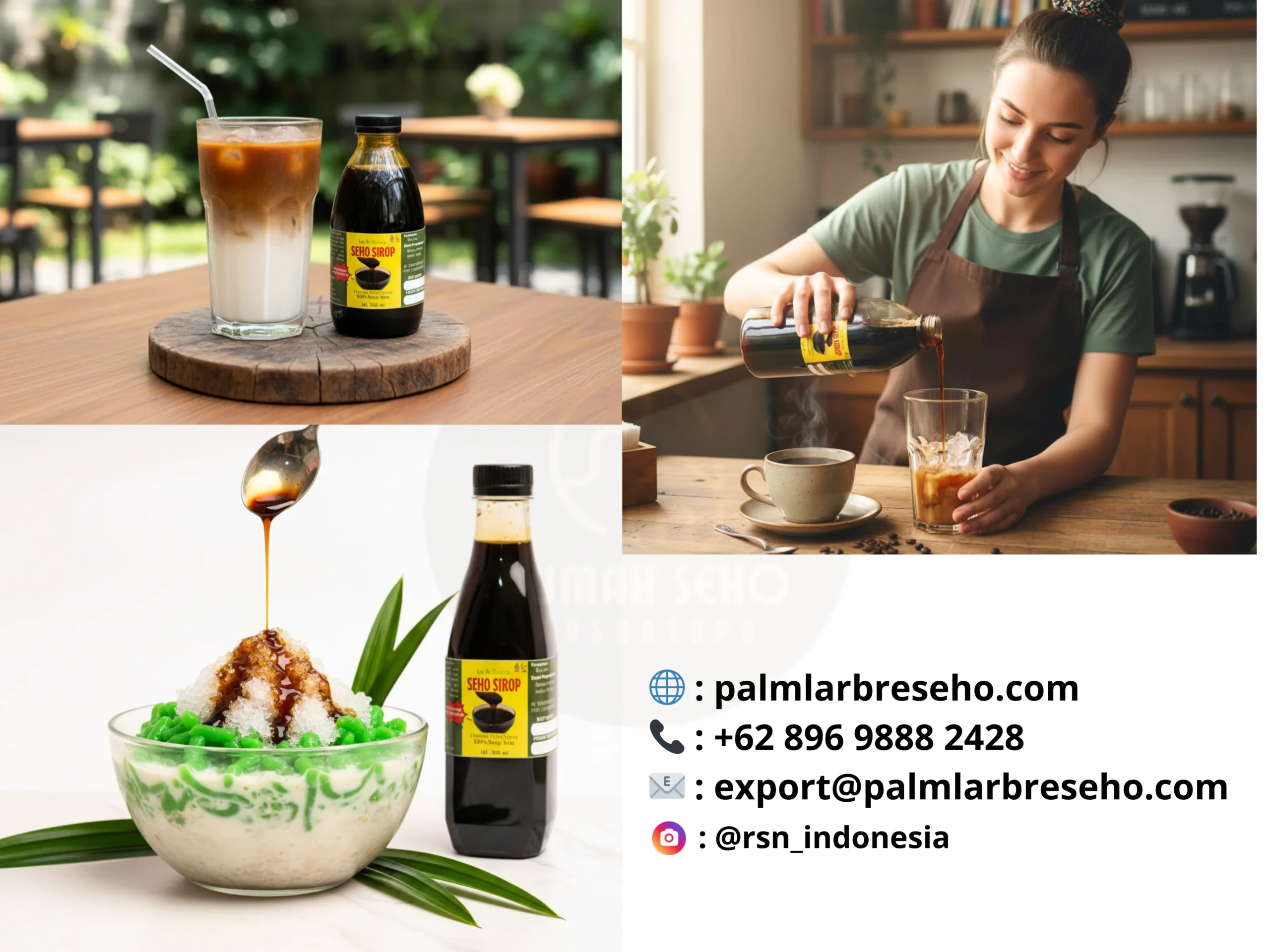
Beverage manufacturers often use palm syrup in tea-based drinks, specialty coffee beverages, and plant-based drinks.
The syrup’s balanced sweetness and subtle caramel flavor complement these products effectively.
Additionally, dessert producers incorporate palm syrup into sauces, fillings, and confectionery formulations.
Because the ingredient is already liquid, it integrates easily into industrial mixing systems.
Within the global palm syrup industry, these applications continue to expand as manufacturers explore new product innovations.
Palm syrup’s versatility allows brands to create distinctive products while maintaining natural ingredient positioning.
Rising Demand for Natural Sweeteners
One of the most important drivers of growth within the palm syrup sector is the global demand for natural sweeteners.
Consumers are increasingly interested in ingredients with recognizable origins and minimal processing.
Many brands now focus on clean-label formulations that emphasize natural sourcing.
Palm syrup fits naturally within this trend because it is derived directly from palm sap through evaporation.
Unlike highly refined sugars or synthetic sweeteners, palm syrup retains natural minerals and flavor complexity.
Consequently, the global palm syrup industry is benefiting from broader changes in consumer preferences.
Manufacturers seeking natural sweetening options increasingly explore palm syrup as part of their product strategies.
Challenges Facing the Palm Syrup Industry
Despite its potential, the palm syrup industry also faces several challenges.
One challenge involves maintaining consistent product quality across production batches.
Because palm sap is a natural ingredient, variations in environmental conditions may influence sap composition.
Reliable producers must therefore implement strict process control to maintain stable ingredient characteristics.
Another challenge involves fermentation risk during shipping.
Palm sap contains natural sugars that may ferment if moisture levels remain too high or microbial contamination occurs during processing.
For global buyers importing syrup across long distances, stability becomes a critical factor.
Therefore, the global palm syrup industry increasingly emphasizes hygienic processing and controlled evaporation systems to ensure product reliability.
The Importance of Manufacturing Standards
Manufacturing standards play an essential role in maintaining ingredient stability.
Reliable palm syrup producers monitor several technical parameters during production.
Moisture content must remain within defined limits to prevent fermentation.
Mineral composition should remain balanced to maintain consistent flavor.
Viscosity stability ensures that the syrup integrates smoothly into industrial formulations.
Through these measures, suppliers can provide ingredients suitable for large-scale manufacturing.
Within the global palm syrup industry, manufacturing standards help build trust between producers and international buyers.
Supply Chain Development for Global Markets
As palm syrup gains international attention, supply chain development has become increasingly important.
Export-ready suppliers must maintain organized logistics systems capable of delivering syrup safely across global markets.
Packaging systems must protect the syrup from contamination and environmental exposure during shipping.
In addition, suppliers must coordinate harvesting networks to maintain stable production volumes.
These supply chain improvements help strengthen the reliability of the global palm syrup industry.
Reliable logistics networks allow manufacturers to source palm syrup confidently for long-term production planning.
Future Opportunities for the Palm Syrup Industry
Looking ahead, the palm syrup industry has significant growth potential.
Demand for natural ingredients continues to rise across global markets.
Meanwhile, beverage manufacturers increasingly experiment with alternative sweeteners that offer distinctive flavor profiles.
Palm syrup’s unique combination of natural origin, flavor complexity, and functional versatility positions it well for future expansion.
As production systems improve and supply chains develop, the global palm syrup industry may become an increasingly important segment within the natural sweetener market.
For manufacturers and ingredient buyers, palm syrup represents an opportunity to innovate while maintaining natural ingredient positioning.
PT Rumah Seho Nusantara: Supporting the Global Palm Syrup Industry
At PT Rumah Seho Nusantara, we aim to contribute to the development of the global palm syrup industry through reliable manufacturing practices.
As a palm (Arenga) syrup manufacturer and supplier from Indonesia, we combine traditional sap harvesting knowledge with modern processing technology.
Our production systems focus on delivering palm syrup suitable for industrial food and beverage manufacturing.
We maintain controlled specifications designed to ensure stable ingredient performance.
Our parameters include:
Moisture: Max 25%
Fat Content: Max 2.5%
Ash Content: 1.10 – 1.15%
These specifications help maintain consistent sweetness concentration, balanced mineral composition, and predictable viscosity behavior.
In addition, our hygienic production systems help reduce fermentation risk during storage and international shipping.
Through disciplined production and transparent communication, we aim to support global manufacturers seeking reliable palm syrup supply.
Contact Us
For more information about our palm (Arenga) syrup and industrial supply capabilities:
🌐 Website: www.palmlarbreseho.com
📞 Phone / WhatsApp: +62 896 9888 2428