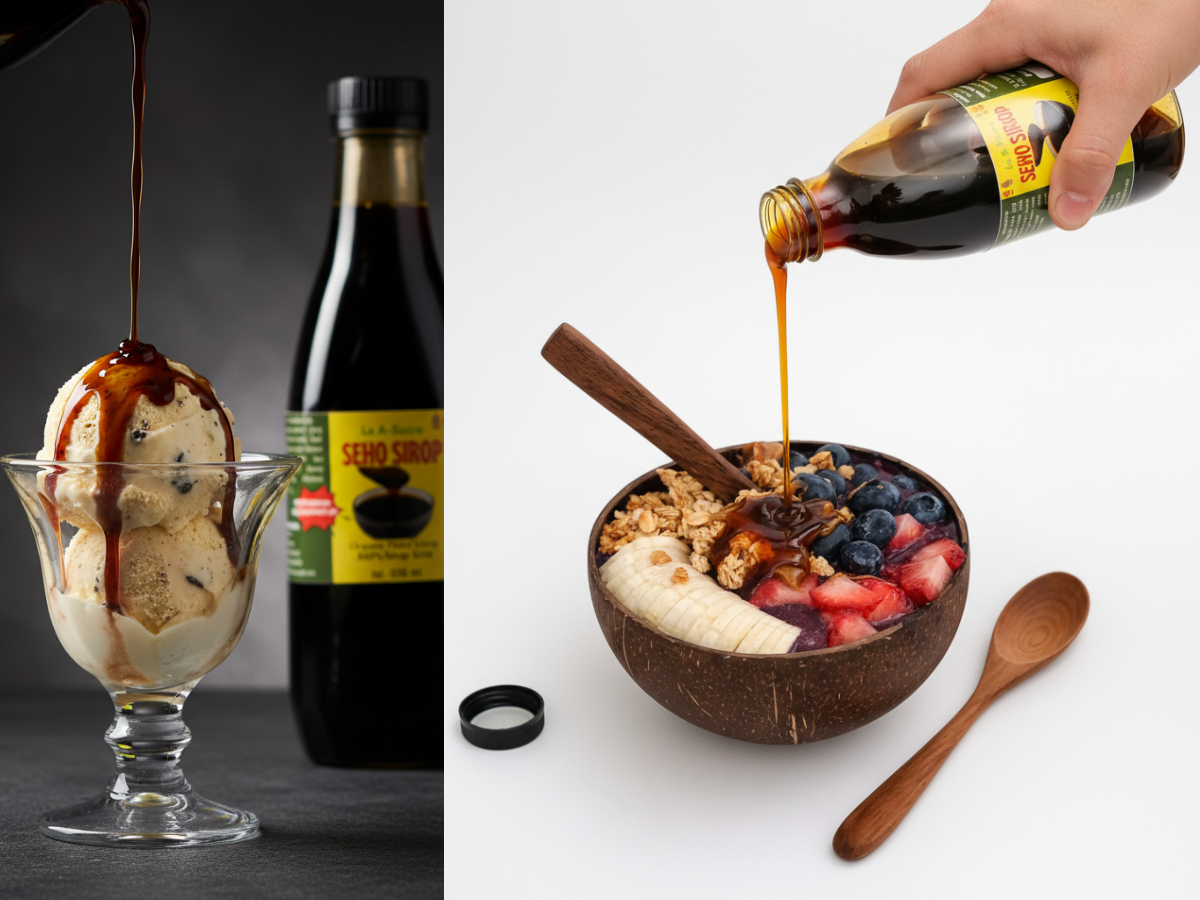
How Seho Sirop Can Support New Product Development in the Beverage Industry
The beverage industry is constantly evolving. Manufacturers are developing new flavors, exploring alternative ingredients, and introducing products that respond to changing consumer preferences and market opportunities.
From ready-to-drink beverages to specialty drinks and functional-inspired concepts, product innovation has become an important part of maintaining competitiveness. For manufacturers, this means continuously evaluating ingredients that can contribute to distinctive flavors, flexible applications, and new product possibilities.
One ingredient worth exploring is Indonesian palm sugar syrup.
Seho Sirop by L’Arbre Seho is a liquid Arenga palm sugar product made from the sap of the Arenga palm (Arenga pinnata). With its characteristic sweetness, caramel-like flavor notes, and liquid format, it offers an opportunity for beverage manufacturers to explore different product concepts beyond conventional sweetening applications.
Rather than limiting palm syrup to coffee, manufacturers can evaluate its potential in tea, chocolate, milk-based beverages, tropical fruit drinks, specialty beverages, and creative applications such as toppings, drizzles, and glazing.
This article explores how Seho Sirop can support new product development and what beverage manufacturers should consider when evaluating it as an ingredient.
1. Why Ingredient Innovation Matters in Beverage Product Development
Developing a new beverage requires more than combining ingredients. Manufacturers must identify a product concept, understand their target market, select suitable raw materials, and establish a formulation that meets sensory and production requirements.
Ingredient innovation can support this process in several ways.
Creating Distinctive Flavor Profiles
Flavor is one of the most important elements of beverage differentiation.
Manufacturers can explore ingredients with distinctive sensory characteristics to develop alternatives to conventional product formulations.
Palm sugar syrup offers characteristic sweetness and caramel-like flavor notes. Depending on the formulation, these characteristics may complement coffee, cocoa, milk, tea, coconut, and selected fruit ingredients.
This creates opportunities to explore new flavor combinations without relying exclusively on conventional sweetening ingredients.
Developing New Product Variations
An existing beverage category can provide opportunities for new product variations.
For example, a manufacturer producing bottled coffee could explore a palm sugar coffee variant. A tea manufacturer could test a palm sugar milk tea concept, while a chocolate beverage producer could investigate how palm syrup complements cocoa.
These concepts allow manufacturers to explore new product directions using an ingredient with a different flavor identity.
Exploring Ingredient Stories and Origins
Ingredient origin can also contribute to product positioning.
Seho Sirop is made from Arenga palm sap, an agricultural resource associated with Indonesia and other parts of Southeast Asia.
For beverage brands interested in incorporating regional ingredients into their product portfolios, Indonesian Arenga palm syrup provides an opportunity to explore a distinctive agricultural ingredient.
Any origin or sourcing claims used in product communication should be supported by accurate supplier documentation.
2. How Seho Sirop Can Inspire New Beverage Concepts
One of the opportunities in product development is exploring how an ingredient can be applied across multiple beverage categories.
Seho Sirop should not be viewed only as a coffee sweetener. Its potential applications can extend to different concepts, subject to formulation trials and product requirements.
A. Ready-to-Drink Coffee Innovation
Coffee remains an interesting category for experimenting with alternative flavor profiles.
Seho Sirop can be evaluated in concepts such as:
- Bottled palm sugar latte.
- Ready-to-drink iced coffee.
- Palm sugar milk coffee.
- Espresso-based beverage concentrates.
- Specialty coffee beverages.
Its characteristic flavor notes may complement coffee and provide a different sensory direction from conventional sweetening approaches.
For manufacturers, the development process should consider sweetness balance, coffee intensity, color, dosage, and mixing behavior.
B. Tea-Based Beverage Development
Tea provides another opportunity for exploring palm syrup.
Potential concepts include:
- Palm sugar milk tea.
- Bottled iced tea.
- Black tea with palm syrup.
- Specialty herbal tea beverages.
- Fruit and tea combinations.
The formulation should preserve the intended tea character while achieving the desired sweetness and flavor balance.
For more delicate tea profiles, manufacturers may need to use a lower syrup dosage or adjust the combination of ingredients.
C. Chocolate and Cocoa Beverage Innovation
Chocolate and cocoa beverages offer opportunities to develop richer flavor combinations.
Seho Sirop can be explored in:
- Ready-to-drink chocolate milk.
- Iced chocolate beverages.
- Palm sugar cocoa drinks.
- Chocolate coffee combinations.
- Cocoa-based beverage concentrates.
The caramel-like notes associated with palm sugar may complement cocoa, creating an alternative flavor direction for chocolate beverage products.
Sensory testing is important to determine whether the syrup enhances the intended profile or creates excessive sweetness.
D. Milk-Based and Plant-Based Beverage Concepts
Milk-based and selected plant-based beverages can also be considered for product development.
Possible concepts include flavored milk, specialty milk drinks, and plant-based beverages using ingredients such as coconut or other suitable plant-derived bases.
In these formulations, manufacturers should evaluate ingredient compatibility, mixing behavior, appearance, and finished-product stability.
The suitability of Seho Sirop will depend on the characteristics of the complete formulation rather than the syrup alone.
E. Tropical Fruit and Specialty Beverages
Indonesia’s tropical agricultural resources offer inspiration for beverage concepts featuring fruit and palm sugar.
Manufacturers can explore combinations involving mango, banana, coconut, and other selected tropical ingredients.
Potential concepts include tropical fruit beverages, fruit-based milk drinks, specialty non-alcoholic drinks, and fruit-and-tea combinations.
The objective is to identify combinations where palm syrup contributes to the desired flavor profile without overpowering the primary fruit character.
These applications demonstrate how one ingredient can be evaluated across different beverage categories to support a broader product development pipeline.
3. Beyond Beverages: Exploring Toppings, Drizzles, and Glazing
New product development is not limited to the liquid beverage itself. Manufacturers can also explore supporting components that enhance product presentation, flavor, and overall experience.
Seho Sirop may be evaluated in selected applications where syrup is used as a topping, finishing ingredient, or component of a larger formulation.
Beverage Toppings
Palm syrup can be explored as a topping component for specialty beverages, dessert-inspired drinks, and selected milk-based products.
For example, manufacturers may test it in layered beverages or as an additional syrup component in chocolate and milk-based drink concepts.
The desired consistency and application method should be established during formulation trials.
Drizzles and Decorative Applications
Seho Sirop can also be evaluated for decorative applications, such as:
- Drizzle inside beverage cups.
- Finishing syrup for specialty drinks.
- Decorative elements in dessert beverages.
- Flavor accents in layered beverages.
These applications may contribute both visual appeal and additional flavor.
However, the syrup’s viscosity, flow behavior, and interaction with the beverage surface need to be assessed to achieve the intended presentation.
Glazing and Dessert Applications
Another product development opportunity is evaluating palm syrup as an ingredient in selected glazing formulations.
Potential applications include bakery products, pastries, dessert toppings, and other sweet food applications associated with beverage concepts.
In these applications, Seho Sirop may be combined with other ingredients to achieve the required consistency, appearance, and finishing characteristics.
Heating conditions, concentration, and formulation composition will influence the final result. Manufacturers should therefore conduct application-specific trials before adopting the ingredient commercially.
4. The Role of Liquid Palm Sugar in Formulation Development
Ingredient format can influence how manufacturers approach product development.
Seho Sirop is supplied in liquid form, which makes it relevant to formulations that require syrup-based ingredients.
Depending on the manufacturing setup, a liquid ingredient may be convenient to measure, dispense, and incorporate into a formulation compared with a solid sweetener that first requires dissolution.
For product developers, this creates several areas to evaluate:
Dosage flexibility: Manufacturers can test different quantities to determine the desired sweetness and flavor contribution.
Mixing requirements: The syrup can be evaluated for compatibility with existing mixing procedures and equipment.
Application versatility: The liquid format can be explored in beverages and selected syrup-based applications, including toppings and drizzles.
Formulation development: R&D teams can assess its role as part of a complete ingredient system rather than treating it only as a standalone sweetener.
However, liquid format alone does not guarantee better processing performance. Actual results depend on the syrup specifications, formulation, equipment, and production conditions.
5. Technical Considerations Before Introducing Seho Sirop into a New Product
An ingredient that works well in a freshly prepared beverage may behave differently in a commercial product.
For this reason, beverage manufacturers should conduct systematic formulation and application testing before moving to full-scale production.
Brix and Sweetness Contribution
Brix is commonly used to indicate the concentration of soluble solids in a liquid.
For product developers, this information helps estimate how an ingredient contributes to the overall formulation.
When evaluating Seho Sirop, manufacturers should request the applicable product specifications and determine the appropriate dosage through formulation trials.
Brix should not be treated as a direct measurement of perceived sweetness, since the final sensory experience also depends on other ingredients and the complete formulation.
Viscosity and Application Requirements
Viscosity influences how a syrup flows during dispensing, pumping, and mixing.
It is particularly relevant when the ingredient is intended for toppings, drizzles, or glazing.
Manufacturers should evaluate viscosity under defined testing conditions and assess whether the syrup is suitable for their equipment and intended application.
Flavor Compatibility
The syrup should complement the other ingredients and support the intended sensory profile.
This is important when developing beverages involving delicate tea, fruit, cocoa, milk, or specialty flavor systems.
Sensory evaluation using different ingredient ratios can help identify the preferred formulation.
Mixing and Dispersion
R&D teams should assess how the syrup incorporates into the complete beverage formulation.
The evaluation should consider mixing sequence, equipment, temperature, and other relevant processing conditions.
The objective is to achieve a consistent formulation that meets the product’s appearance and quality requirements.
Processing Compatibility
Commercial beverages may undergo different processing methods depending on their category and intended shelf life.
Manufacturers should evaluate the syrup under the actual processing conditions planned for the finished product.
Any changes in flavor, color, physical characteristics, or other quality parameters should be documented during development.
Finished Product Stability
Successful initial formulation does not automatically establish commercial shelf life.
The finished beverage should undergo appropriate stability and quality testing under its intended packaging and storage conditions.
Depending on the product, this may include sensory evaluation, physical stability, microbiological quality, and other relevant parameters.
These assessments are necessary before determining commercial suitability and shelf-life claims.
6. From Product Concept to Commercial Production
A structured development process helps manufacturers move from an initial idea to a product that can be produced consistently.
When evaluating Seho Sirop, the following stages can provide a practical framework.
Stage 1: Identify the Product Opportunity
Define the beverage category, target consumer, desired flavor profile, and market positioning.
Stage 2: Select the Ingredient Application
Determine whether Seho Sirop will be used as a sweetening ingredient, flavor component, topping, drizzle, or part of a larger formulation.
Stage 3: Request Product Information and Samples
Obtain available technical specifications and samples for preliminary evaluation.
Stage 4: Conduct Formulation Trials
Test different dosage levels and ingredient combinations to establish the preferred sensory and physical characteristics.
Stage 5: Evaluate Processing and Stability
Assess the formulation using the intended manufacturing process, packaging, and storage conditions.
Stage 6: Standardize the Formulation
Document ingredient quantities, mixing sequence, processing conditions, and finished-product acceptance criteria.
Stage 7: Evaluate Commercial Requirements
Review sourcing arrangements, packaging, supply capacity, purchasing volumes, and delivery requirements before commercial implementation.
This process helps align R&D, quality assurance, procurement, and production teams throughout product development.
7. Why Beverage Manufacturers Should Explore Seho Sirop
Seho Sirop is part of L’Arbre Seho, a brand of PT. Rumah Seho Nusantara, an Indonesian palm sugar manufacturer and exporter.
Made from Arenga palm sap, Seho Sirop provides an opportunity for beverage manufacturers to explore an Indonesian agricultural ingredient in different product concepts.
Its potential applications extend across several areas:
- Ready-to-drink coffee and milk beverages.
- Tea-based and chocolate beverages.
- Tropical fruit and specialty drinks.
- Dessert-inspired beverage concepts.
- Beverage toppings and drizzles.
- Selected glazing and dessert applications.
Its liquid format also makes it relevant to product concepts that require syrup-based ingredients.
For manufacturers, the opportunity is not simply to replace one sweetener with another. It is to evaluate how the ingredient’s flavor characteristics and physical properties can contribute to new product concepts.
The final suitability of each application should be established through technical evaluation, formulation trials, and finished-product testing.
Conclusion
New product development is an important driver of innovation in the beverage industry. Manufacturers need to continuously explore ingredients that can contribute to distinctive flavors, new product variations, and creative applications.
Seho Sirop offers an opportunity to explore Indonesian Arenga palm sugar across a range of beverage concepts, from ready-to-drink coffee and tea to chocolate, milk-based, and tropical fruit beverages.
Its potential also extends beyond beverages into selected applications such as toppings, drizzles, and glazing.
For R&D teams and beverage manufacturers, the next step is to evaluate the ingredient through structured formulation trials, technical assessment, and commercial sourcing discussions.
PT. Rumah Seho Nusantara, through its L’Arbre Seho brand, welcomes opportunities to discuss Seho Sirop with businesses interested in exploring Indonesian Arenga palm syrup for beverage product development.
Whether you are developing a new RTD beverage, expanding an existing product line, or exploring creative syrup applications, Seho Sirop is worth considering as part of your next product development project.
Contact Us
PT. Rumah Seho Nusantara – L’Arbre Seho
- Website: palmlarbreseho
- Email: export@palmlarbreseho.com
- WhatsApp: +62 896 9888 2428
- Instagram: @rsn_indonesia
Contact our team to discuss product specifications, sample requests, packaging options, and potential sourcing arrangements for your beverage manufacturing business.